15 days in: onboarding at a multiplayer AI company
 Janet Gehrmann
I just had my 15-day check-in at Dust. Here’s what I’ve learned about onboarding at a company where people and agents work from shared context.
At Dust, onboarding starts with shared context. New hires read the company’s decisions, conversations, and documentation, use Dust to investigate questions independently, and then go to people for the judgment that documents cannot provide.
Fifteen days into my role, the surprising part is not how much onboarding happens online. It is how the online and in-person parts work together.
Why onboarding still starts in person
Dust is a multiplayer AI platform where people and agents collaborate from shared company context. Much of that context is written down in Notion, Slack, and GitHub, and Dust makes it easier to search and use. It would be reasonable to assume that onboarding could happen entirely online, especially since I’ll be based in San Francisco as part of the US team.
Instead, my first two weeks started with a flight to Paris, Dust’s global headquarters and original home. The purpose was not simply to transfer information. It was to build relationships around the context that already exists online.
Most days were self-directed. I decided what to read, what to research, and which questions to ask next. But being around the team changed the quality of those questions. During a company gathering, I asked detailed questions about how eng-runner rotations work, a conversation that probably would not have happened over a video call.
That experience clarified the role of in-person onboarding at a multiplayer AI company. Shared context helps new hires move independently. Time with colleagues adds judgment, history, and connection. Both are necessary to become useful quickly.
Why it’s called a “spin-up”
Dust doesn’t call this onboarding. It’s called spinning up, and the name is borrowed from engineering on purpose. You don’t spin up a server and let it sit idle while it “gets oriented.” You spin it up and it starts doing work.
The principle is simple: ship something meaningful in your first week, even if it’s small. Ask questions and use Dust to answer the ones you can before asking a person. Get real autonomy immediately instead of earning it later.
Most onboarding programs I’ve experienced had a passive first week: benefits enrollment, endless slide decks, and general orientation. Here, because so much of the context is written down and searchable, that passive part takes less time. The rest is active, self-directed, and largely on you.
That is also why conversations can go deeper. After spending the morning reading and researching independently, I was not starting from zero when I sat down with someone.
The context people add
I was assigned Ambra, our Chief of Staff, as the person to contact if I got lost. But the heavier lifting happened through a series of informal conversations with people from teams I had not yet met.
Those conversations gave me context I could not have found in Notion alone: which decisions were hard-won, which ones were still debated, and who to ask when something broke. Documentation can preserve the record of a decision. People explain the judgment behind it.
What the AI-native part changes
So what does the AI-native part of onboarding change? Two things, from what I’ve seen so far.
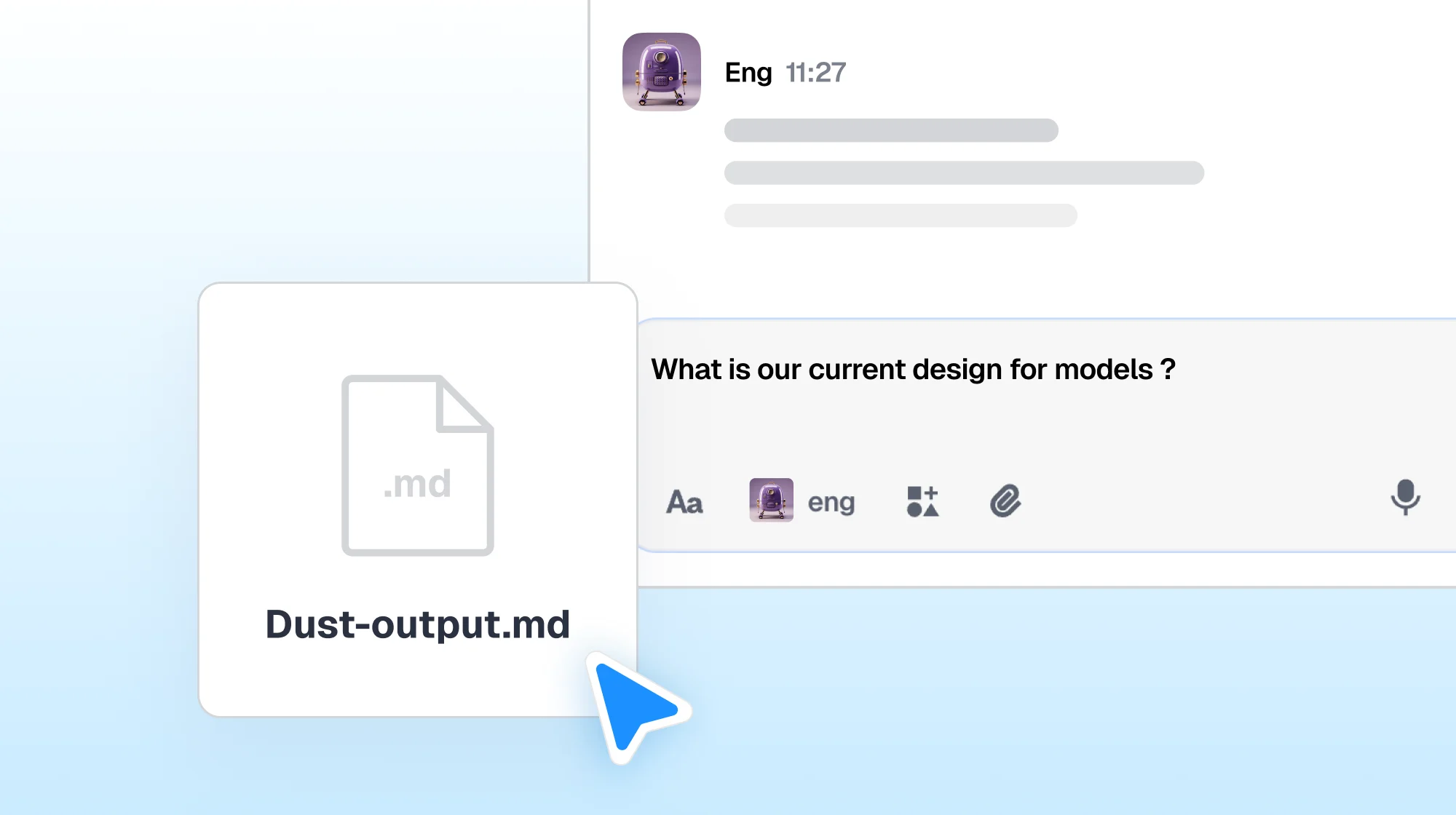
First, documentation becomes part of the culture, not a supplement to it. Important decisions and working context are documented so teammates can find useful background without starting from zero. During onboarding, I could use Dust to locate relevant company knowledge and find answers to questions that had already come up.
When I wanted to understand the product better, I could watch recorded product walkthroughs and explore multiple examples in succession. When I wanted to understand a company priority, Dust helped me find the relevant background before I followed up with a colleague. When I needed to find an internal policy, I could ask Dust instead of searching through multiple documents.
Second, new hires use the product and start contributing immediately. Day one included setting up a development environment and getting hands-on with the product I would be working with. You learn Dust by using Dust, from the first morning.
Why the 15/40/100 framework matters
Dust’s onboarding is structured around three check-ins: at 15, 40, and 100 days. Each marks a different stage of becoming useful.
At 15 days, the question is whether a new hire is developing product intuition and learning how to navigate the company’s shared context. At 40 days, the focus shifts to contribution: shipped work, closed deals, useful documentation, or a customer problem solved. By 100 days, the expectation is sustained autonomy, not continued orientation.
The framework is less about ticking an HR box than making autonomy visible. The 15-day check-in asks whether a new hire has enough context to contribute and whether anything is getting in the way. That is more precise than asking whether someone is happy. It also captures a perspective only a new hire can provide: what is clear, what is confusing, and where the company still depends on tribal knowledge.
The 40-day check-in will show whether early product intuition has turned into concrete contribution. The 100-day check-in asks whether that contribution has become sustained autonomy.
That is the larger lesson of my first 15 days. AI-native onboarding is not about removing people from the process. It is about making more of the company’s context available before you need someone’s help, then using conversations with people for the judgment and perspective that documentation cannot provide. At a multiplayer AI company, agents, shared context, and colleagues all play a role in helping a new hire move from learning to contribution.
Explore how people and agents can collaborate from shared company context. Get in touch →