Building Help Behind AI Agents: Support Engineers Role At Dust (we’re hiring!)
 Ilias
Ilias
Do you really care if you didn’t write every word you sent? How to engineer better support? In other words: what does Putting Users First mean in a world where Humans and AI Agents flock together at work?
Users First in practice
The guess and the guest
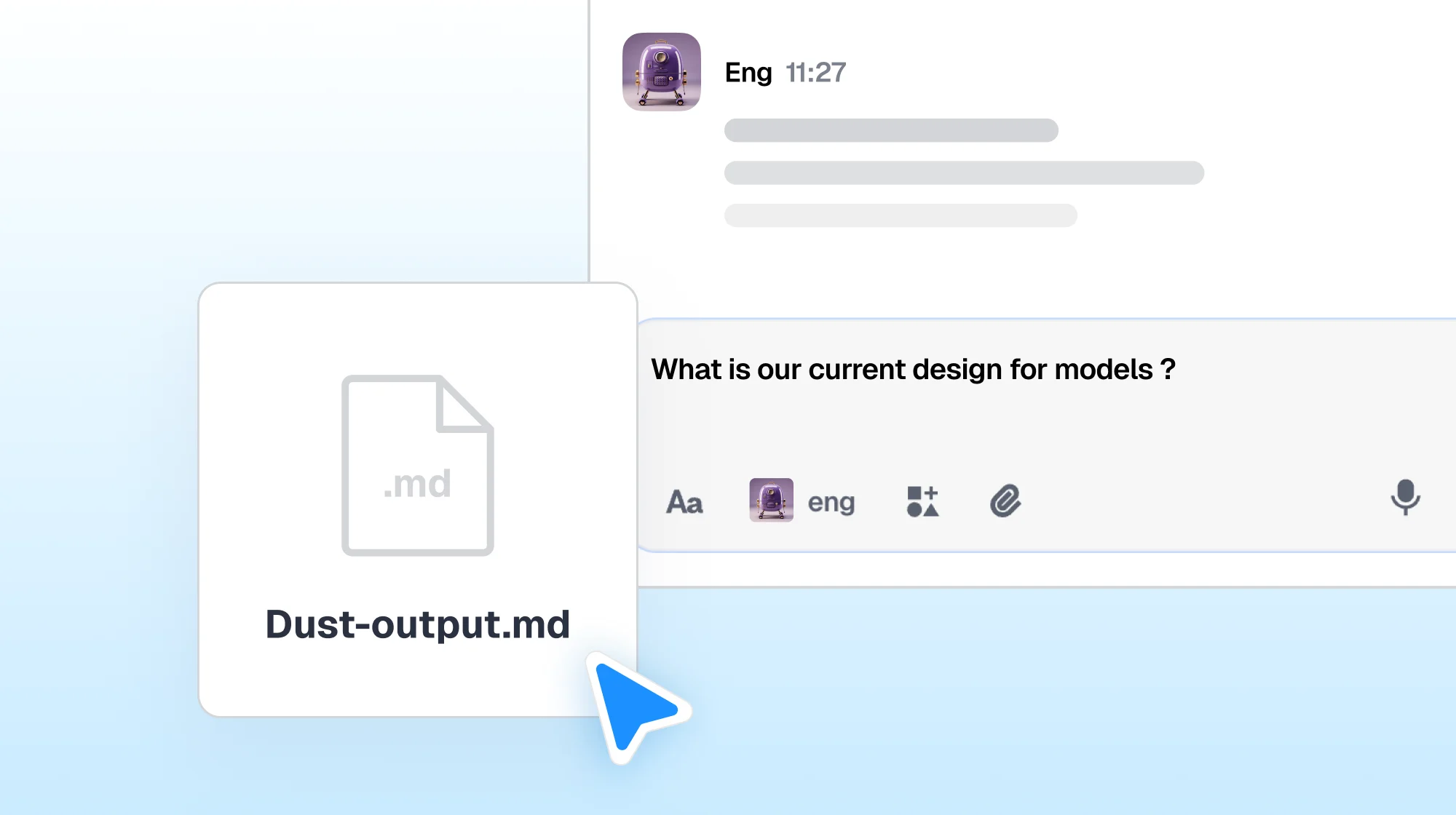
Support investigations are research problems, and the bottleneck is almost always knowledge gathering for making hypotheses. Our @support agent eliminates that by pulling everything into a single conversation: Stripe subscription, Datadog logs, codebase files, Slack threads, internal runbook, and public documentation.
What used to take our eyes to search across six tools now takes an agent a few minutes of retrieval, so we spend time on the actual problem instead of hunting for information.
Enabling its Skills, the agent generates three hypotheses and simultaneously asks reviewer subagent for feedback. Once clean of any criticism, the polished answer gets packed in a draft ready to be reviewed by a human and then sent to the user.
The role of Support Engineers is no longer to answer tickets. It’s to equip agents to investigate, catch bugs, and close knowledge gaps themselves, while humans stay accountable when things go wrong. This LLM-as-judge flow sets new expectations: deep knowledge of the product architecture, tenacity in reproducing issues, and the instinct to turn any ambiguous detail into elegant truth.
If you’re reading this and feel that’s you, apply here!
This also begs the question: are the reports good enough to begin with?
X Y and Z are in a boat
Users rarely describe the pain, they describe what they think the solution is: it’s the XY problem. Y is the root cause and X is what the user thinks they need. The same diagnosis can also mask two different issues, so there needs to be digging beneath the tandem.
With Triggers, customer requests directly prompt our @support agent to the codebase, tracing backward through the relevant product behavior. Our strategy is to have an orchestrator @loop agent whose job is to get the necessary and sufficient information from the user: a URL, a screenshot, or sometimes even a video.
We don’t rewrite answers for each customer anymore, but we design how they get produced. We engineer help to get 80% of everything drafted. The remaining 20% is a mix of care, refinement, and review scrutiny. Engineers think in X, Sales think in Y, and Support sits in the middle. Ensuring our agents get to challenge the core X is the step zero to enable investigating the Y. The Z is a nugget that closes the gap beyond the original ask.
Now what does that leave for the human behind?
From Bits to Dust
Engineering Support
The more you automate, the more the human layer matters. With eclectic ideas, memorable advice, and sharper edits. Agents can generate answers in seconds. But what users remember isn’t speed, it’s whether they felt understood, guided, and actually helped. Our everyday challenge is to spark those epiphanies that make our users want to stop everything, create new joyful things, and share them with all their colleagues.
Language models forced Support into becoming an Engineering problem. It doesn’t mean erasing the Customer part. It means shifting the focus into creating a system that generates strong answers and becoming expert at challenging them. Behind every good agent, there's someone who encoded intent, constraints, and taste into it.
Why couldn’t an AI do that job?
Review is the new scarce
Physicist David Deutsch argues we don’t have a theory for objective beauty yet, it may have something to do with playing between order and chaos; expectation and surprise. Deutsch’s intuition is that human creativity came with the ability to disobey existing patterns for better ones.
Our agent Sidekick does a great job at suggesting where an intention for change is best applied. Refuting the next token? Looks like the models aren’t there yet. In a world where a huge amount of ideas and solutions can be drafted for your eyes to see, the ability to review and pick the right ones with taste is rapidly becoming the bottleneck.
Support Engineers are facing this tension every day: our expertise was needed in breadth, it is now also needed in depth, and for safety.
In a world where answers are infinite, judgment becomes the bottleneck. That's the job. And if still in doubt before sending, remember that Love is the answer!
Want to see how it works in practice? Discover what you can build on Dust →