We Build AI Agents: Here's How We Use Them to Scale Our Own Case Studies
 Karen Chalco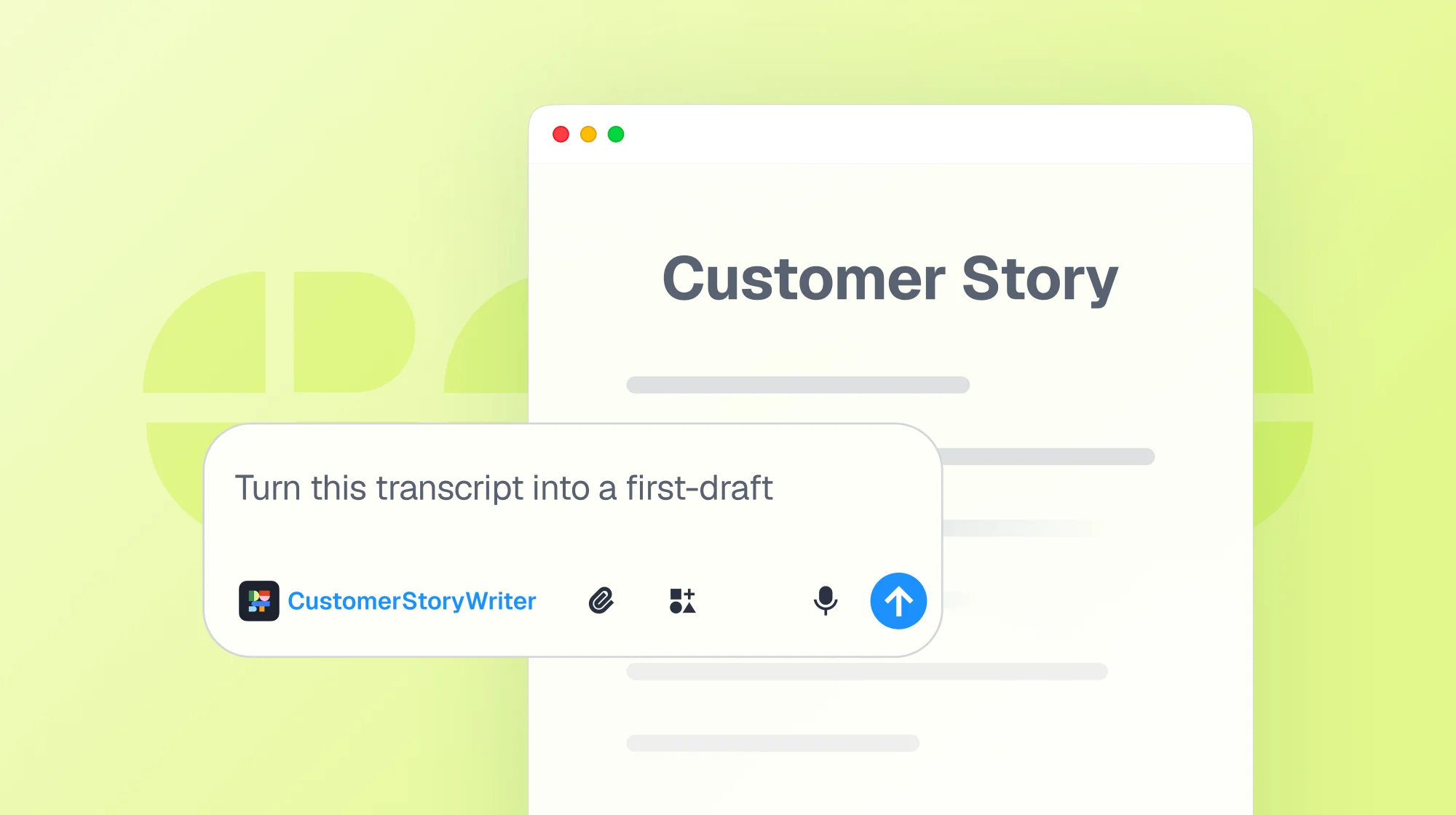
By Karen Chalco, Content Marketing at Dust
Case studies, or customer stories as we call them at Dust, are one of the highest-value pieces of content a company can produce. They're the thing a sales rep drops into a deal when a prospect says "do you have any customers like us?" They're the thing that sits on your website and does quiet, compounding work long after you've moved on to the next thing as a marketer.
They're also, historically, a lot of work to produce well. Even with a relatively short interview with a customer (thirty, forty-five minutes), the process of going from a recorded conversation to a published article is long and manual. You play back the recording, take notes, draft an outline, write the thing section by section, make sure you didn't miss anything, share internally, get feedback, share with the customer, and then wait. And wait some more.
When I joined Dust, I knew I was walking into a company that builds specialized AI agents, which meant I had access to those capabilities from day one. And maybe more importantly, I was surrounded by people who had already been using them to redesign the parts of their jobs that used to feel like a grind. So that's what I aimed to do with customer stories, one of my biggest mandates as a marketer at Dust.
Over the last couple of months, I've built a system of Dust agents around my customer story process that handles the coordination, the research, the drafting, and the pipeline tracking. By the time I sit down with a customer for an interview, I'm not thinking about logistics. I'm just there for the conversation.
Here's what that system actually looks like.
Step 0: The Frame that replaces me in every intro email
The first thing I noticed when I started coordinating customer stories was how much time got eaten up by introductory questions. Customers and their relationship managers would loop me into a Slack thread, and within a day or two there'd be a familiar cluster of questions: What does this process look like? How long does it take? Will you publish anything without my approval? What do you need from me ahead of time?
All completely reasonable questions. But I was answering them over and over, and I started to feel like a significant portion of my job was just repeating myself.
So I built a Dust Frame, a shareable, interactive visual, that answers all of those questions before I'm ever brought into the conversation. It walks customers through the process from end to end, tells them what to expect, and includes a homework tab: a set of questions that typically come up in interviews, so they can start thinking ahead of time about their Dust setup, their workflows, and the outcomes they've seen.
The best part is that my AE or CSM colleagues can send it directly to a customer without needing me involved at all. By the time we actually connect, the customer already knows what we're doing together and has had a chance to think about it. It sounds like a small thing, but it has allowed me to accelerate the customer story process while bringing a sense of delight to the customer on the receiving end.
Step 1: @Dora’sCustomerStoryPrep: research while I'm still asleep
At any given point, I have a handful of customer story interviews scattered across my calendar, some in the next couple of days, some a few weeks out. Before I built @DorasCustomerStoryPrep, this meant I was doing research in a rush the morning of, or the day before.
Now, every Monday and Wednesday at 5 a.m., the agent runs automatically. It reads my Customer Story Pipeline Tracker (a Google Sheet where I keep every customer at every stage of the process), pulls the company names I'm actively working with, and cross-references them against my Google Calendar to find upcoming interviews. If there's nothing on the horizon, it stops and does nothing. If there's a match, it gets to work.
For each upcoming interview, it pulls Fathom transcripts from past sales and customer success calls with that company, looking for pain points, notable quotes, and any mentions of ROI or delight that they’ve experienced with Dust. It checks HubSpot for deal history and account details. It searches Gmail and Slack for any recent context a colleague of mine might have shared. It looks up each meeting attendee on LinkedIn to understand their role and background. It does a quick web search for a public overview of the company. Then it pulls everything together into a prep brief, delivered as a Frame, with proposed story angles already included.
I got the idea from watching our post-sales team, who had built something similar for customer calls. They manage so many relationships that walking into a call without a brief would just be unsustainable. I realized I had the exact same situation, just applied to interviews instead of check-ins. So I borrowed the concept and adapted it for my workflow.
By the time I sit down for an interview now, I know who I'm talking to, what their history with Dust looks like, and where I think the most interesting story probably lives. That changes the quality of the conversation significantly.
Step 2: The interview itself
One thing to note: it's easy to read an article like this and assume that building systems means showing up less. For me, it's the opposite.
Because I'm not stressed about logistics, I can actually be present for the interview. I'm not mentally flipping through what I need to remember to ask. I'm just listening. And the moments that make a customer story worth reading almost always happen when you're listening closely enough to catch them: the unexpected detail that opens up a whole different angle, the offhand comment about an outcome that turns out to be the real story, the moment where someone gets genuinely animated talking about something that mattered to them.
That part isn't going anywhere. Everything around it, though, I'm happy to hand off.
(A quick note: I make sure to ask for permission before recording, and we make sure to anonymize the data.)
Step 3: @CustomerStoryWriter: from transcript to draft in a fraction of the time
After the interview, I take the Fathom transcript of the meeting and bring it into @CustomerStoryWriter, a custom agent I inherited from my predecessor on the marketing team, who had the foresight to build it before I arrived. I consider this one of the nicest professional gifts I've ever received.
What makes this different from dropping a transcript into a general AI tool is that this agent knows exactly how we structure our customer stories at Dust: the highlight block at the top, the challenge section, the solution section, the results section, the formatting, the writing guidelines, the things we do and don't do. It has examples of what good genuinely looks like.
The output is an actually solid first draft. Not publish-ready, but far better than a blank page and structured the way we actually want it. I do a pass to verify accuracy, reframe anything that needs it, and add nuance & personality where the transcript didn't quite capture it. Then I share it with the customer for review and approval.
The whole process, end to end, is at least four times faster than it would be otherwise. And I'd argue the output is actually better, because the time I'm not spending on the mechanical parts of drafting is time I can put toward the editorial judgment: what's the most interesting angle, what detail deserves more space, what does this particular story reveal that's worth saying.
Step 4: @Dora’sInternalLinker: SEO, handled before anything goes live
Before anything gets published, I run the draft through the @Dora’sInternalLinker agent. Internal linking is one of those things that matters a lot for SEO and is deceptively easy to deprioritize when you're deep in the weeds on a piece of content.
The agent fetches our website’s live sitemap, analyzes the article to identify its main topic and supporting themes, scans the sitemap for topically relevant pages, fetches the content of each candidate to confirm it's actually a good fit, and then presents its suggestions in a table with the URL, the anchor text already present in the article, the surrounding sentence for context, and a brief explanation of why the link makes sense. I review and approve, and it implements the links directly into the article.
It takes maybe five minutes. It consistently surfaces connections I would have missed or not had the bandwidth to go find on my own.
Bonus: keeping the pipeline current without lifting a finger
Throughout all of this, most of the coordination around customer stories happens in Slack. I'll be in a thread with a CSM, talking through whether a customer is ready to be approached, whether a review has come back, when something has been published. Those conversations carry a lot of important status information that needs to live somewhere. That’s why I built a google sheet that I call my customer story pipeline tracker.
Rather than tabbing over to that google sheet after every thread, I just ask the default Dust agent directly in the Slack conversation to update the relevant row in my Customer Story Pipeline Tracker. The default agent is more than powerful enough for this kind of one-and-done task. The sheet stays current, the team has visibility, and I'm not doing administrative data entry at the end of a long day. Sometimes the right tool is the simplest one.
Some parting thoughts…
The customer story engine is one of the workflows I’m most proud of since joining Dust. Other parts of my content workflow are still more scrappy, and I think that's okay. You don't need to automate everything at once; you start with whatever is creating the most friction.
For me, that was customer stories. The high stakes, the coordination overhead, the drafting time — it all added up in a way that made scaling feel daunting. Now it doesn't. And the parts I actually love about this work (the conversations, the storytelling, the editorial decisions) are still mine.
That's probably the thing I'd most want someone to take from this. The goal isn't to automate the job. It's to clear enough space that you can hone in on your craft with the passion & intentionality that it deserves.