Dust raises $40M Series B to scale multiplayer AI for human-agent collaboration
 Gabriel Hubert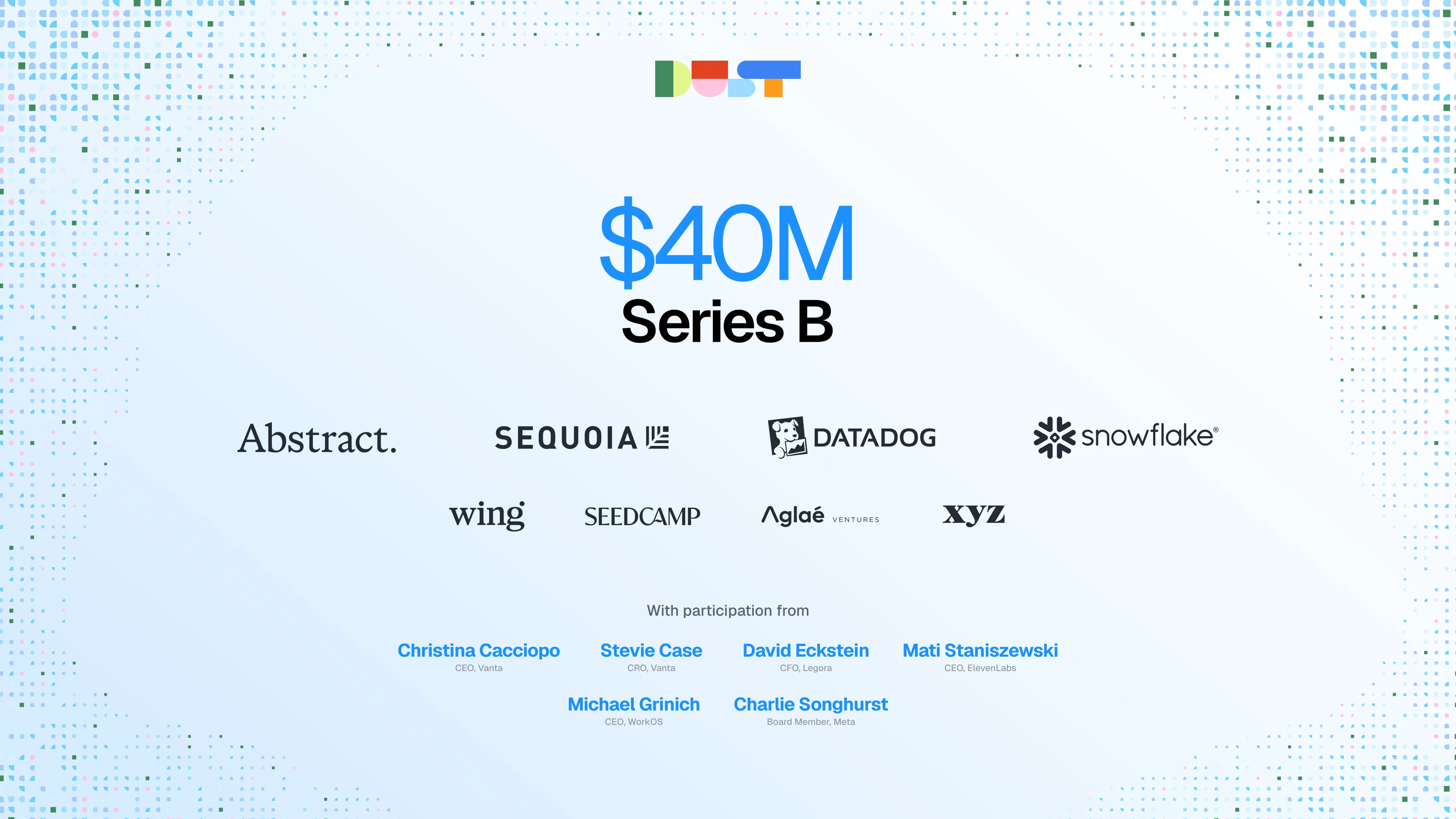
Three years ago, we started Dust with a core conviction: as AI models improve at an unprecedented pace, companies will need a new type of system that turns raw model capability into coordinated, compounding work across teams.
Today, Dust is used by more than 3,000 organizations globally, from high-growth AI-native companies to established enterprises. Across those companies, the people closest to the work have deployed more than 300,000 agents. At Clay, Dust serves as foundational knowledge infrastructure for a rapidly growing GTM team. At Profound, it has become the source of truth for customer intelligence and post-sales. At Persona, teams across 11 departments have deployed more than 300 Dust agents. And at Doctolib, Dust is central to a company-wide AI strategy reaching 3,000 employees.
Across all of this, one thing has become clear: organizations don’t need standalone agents rolled out employee by employee. They need a shared system where humans and agents can work together in parallel, with the same context, tools, and aligned goals.
We call this multiplayer AI. Today, we’re announcing a $40M Series B with Abstract, Sequoia, Snowflake Ventures, and Datadog to accelerate building it.
The single-player AI bottleneck
Most companies today are stuck in single-player AI mode. Everyone gets access to their own agent, which can do work on their behalf, like researching a prospective account or creating a presentation, with a limited set of knowledge and tools. Each person might get some of their work done better or faster, but productivity stays trapped with individual people, and within their instance of a tool. The benefits don’t compound across the team.
What this looks like in practice is the sales rep who saves time by using AI to research an account before the call, but the SE running technical discovery the next day starts from scratch. It’s the product marketer who uses AI to draft the one-pager, the content writer who writes the blog from their own version of the brief, and the sales enablement manager who builds the battlecard from an entirely different deck.
As people within organizations delegate more of their workload to AI, the bottleneck shifts from generation to coordination. The question is no longer simply whether AI can do the work; it’s whether teams can coordinate work across many people and many agents at once, with seamless reviews, approvals, handoffs, and shared visibility as work moves in parallel. Enabling that degree of human-agent collaboration is what unlocks compounding productivity gains across the entire organization.
Human-agent collaboration
Multiplayer AI can’t be built as a thin layer on top of a chatbot. The hard part is no longer prompting AI to produce an output; it’s designing the system that allows humans and agents to share context, use the right tools securely, and facilitate reviews and handoffs to keep work moving forward. That’s why we built Dust as a system for operational collaboration from the beginning, not just an interface for interacting with a model.
Shared workspaces
In Dust, that collaboration happens inside persistent, shared workspaces established around a team, initiative, or workflow. Instead of operating in isolated sessions, agents work alongside people with access to the same context, tools, skills, and work that’s already been done.
Context layer
Many tools can connect to other systems, but there’s a difference between connecting and understanding. Dust goes further: it helps agents make sense of information across sources, synthesize it accurately, and take action. It does this through a hybrid approach to enterprise knowledge: semantic search for deep ongoing contextual understanding and high-quality synthesis, plus MCP connections for simple queries and actions across tools.
Self-improvement
Most agents are static, meaning they perform the way they were initially configured until someone manually updates them. Dust creates a continuous improvement loop around organizational work where every interaction generates signal. Teams refine workflows over time, agents accumulate memory and context, and Dust identifies patterns across conversations to suggest improvements to agent instructions and skills.
Observability and governance
Admins get complete visibility and control over every agent interaction. That means granular permissions, cost and usage monitoring, a full audit trail, and agent analytics, all in one place. Dust is also SOC 2 Type II certified, GDPR compliant with EU/US data residency, and guarantees zero model training on your data.
Multiplayer AI in practice
If you think about the most complex work that happens at companies today, it’s not being done by just one person in isolation. Launching a product, onboarding a customer, conducting deal reviews, and running competitive teardowns can each involve dozens of humans and agents working in parallel sometimes over weeks and months — researching, synthesizing information, generating deliverables, coordinating follow-ups, and taking action from the same live context.
To coordinate this very announcement, Stan and I worked with our marketing, data, and operations teams together in Dust, running parallel workstreams with multiple people and agents contributing simultaneously.
While humans made decisions, refined messaging, and coordinated approvals, agents synthesized data and updates from Slack, Snowflake, HubSpot, Notion, Gmail, and Google Drive. Our marketing team collaborated with agents to draft this blog post, prepare investor quote sheets, generate social copy, and build customer communication kits. Our data team's agents pulled the metrics you'll read below, live from our data warehouse. Our ops team coordinated the launch timeline, media embargo schedule, and approval workflows, with agents flagging blockers and @mentioning the right person when a decision was needed.
Work no longer moved linearly between isolated teams, tools, meetings, and approval chains. Agents advanced work in parallel, while humans stepped in at the moments that required judgment: refining the message, approving next steps, resolving blockers, and making final decisions. Our human teammates and their agents worked from the same context, inside the same workflows, with shared visibility into decisions and progress. This is what multiplayer AI feels like in practice, and it’s how Dust operates every day.
AI Operators rewriting work
We’re a company that runs on what we’re building. Dust is the primary tool used by everyone on every team, from engineering to GTM. That’s why we’re certain that the people who transform organizations with AI won’t be external consultants, forward-deployed engineers, or centralized innovation teams. They’ll be the operators closest to the work:
- The growth marketers rebuilding outbound
- The RevOps managers bridging gaps across the stack
- The GTM engineers rethinking how revenue gets generated
- The data analysts automating reporting
- The product marketers orchestrating complex launches
- The support managers automating escalations and renewals
- The recruiters compressing hiring cycles
We call these people AI Operators. They use their functional expertise to rewire how their organizations work. Dust is built for them.
We believe the next generation of organizations will operate as integrated systems of humans and agents collaborating together in parallel. Multiplayer AI is the system they’ll run on. That system is Dust.