2025 Dust Product Update Recap
 Pauline Pham
The AI world moved fast in 2025, but the Dust team moved faster.
We started 2025 with a vision: a shared space where teams across your organization work together with fleets of specialized AI agents. We wanted to make AI agents colleagues you trust to help you get work done faster and to a high standard. Agents that work alongside you, not just for you, as true collaborators. They remember who you are, work while you sleep, and contribute to your systems, not simply read or search them.
That vision drove us through hundreds of updates and 1,000+ commits per month. Yes, our engineers have certainly earned a well-deserved end-of-year break.
Your feedback shaped every feature and your requests pushed us to build things we hadn’t imagined.
Your trust kept us focused on what matters: building THE operating system for the AI era, where you can deploy, orchestrate, and govern fleets of specialized AI agents that work alongside your team, safely connected to your company's knowledge and tools.
To every customer who helped us get here, thank you for building the future of work alongside us. It’s been (and continues to be) a pleasure.
The full list of everything we shipped could fill a small novel, but we've got work to do, and so do you. So here are the…
Highlights ✨
1. Companies got agents that think deeper about complex problems
In the beginning of the year, advanced reasoning capabilities arrived with new variants of DeepSeek, Sonnet, and o3-mini, giving agents the ability to work through multi-step analytical problems. The BigQuery Connection let agents query data warehouses directly. Label filtering got smarter. Keyword search in the agent builder meant you could finally find that buried data source. Better markdown support made responses clearer.
2. Teams connected agents to where work happens
Gong, Gmail, Google Calendar, Salesforce, HubSpot, and Notion integrations meant agents could read from and write to your actual workflows. Draft emails from your personal account. Schedule meetings with context. Update CRM records. Create and modify Notion pages.
Agent chaining let specialized agents collaborate. A research agent gathers information that a writing agent transforms into a report, with sub-agents running simultaneously in parallel.
User provisioning automated workspace management. Sync users and groups directly from Okta, Entra ID, or Google Workspace. Users get automatically added, assigned to the right teams, and removed when they leave.
3. Agents learned to remember and take action
Agent Memory arrived. Your agents now remember your preferences, ongoing projects, and past interactions across all conversations. Each user has their own memory space with each agent.
The Slack tool let agents post messages to channels from your account. Linear integration enabled issue creation and tracking. Outlook support brought email and calendar management to Microsoft workflows.
4. Work started happening autonomously
Scheduled agents run daily reports, weekly summaries, and data syncs without human initiation. Agents gained access to tools and data across multiple Spaces for powerful cross-functional workflows. The Excel extension brought Dust into spreadsheets.
MCP integrations expanded to Asana, Jira, GitHub, Google Drive, and more. The improved agent builder made creation easier with better tool selection and streamlined UX.
5. Agents started working while you sleep
Triggers made agents fully autonomous. Schedule them using natural language, activate from webhooks, let them write back to your systems. GitHub, Zendesk, Fathom, Linear, and Jira events trigger agents when PRs open, tickets arrive, or issues update.
Builder Observability shows exactly where agents excel and where they struggle. Success rates, token usage, performance metrics for every agent.
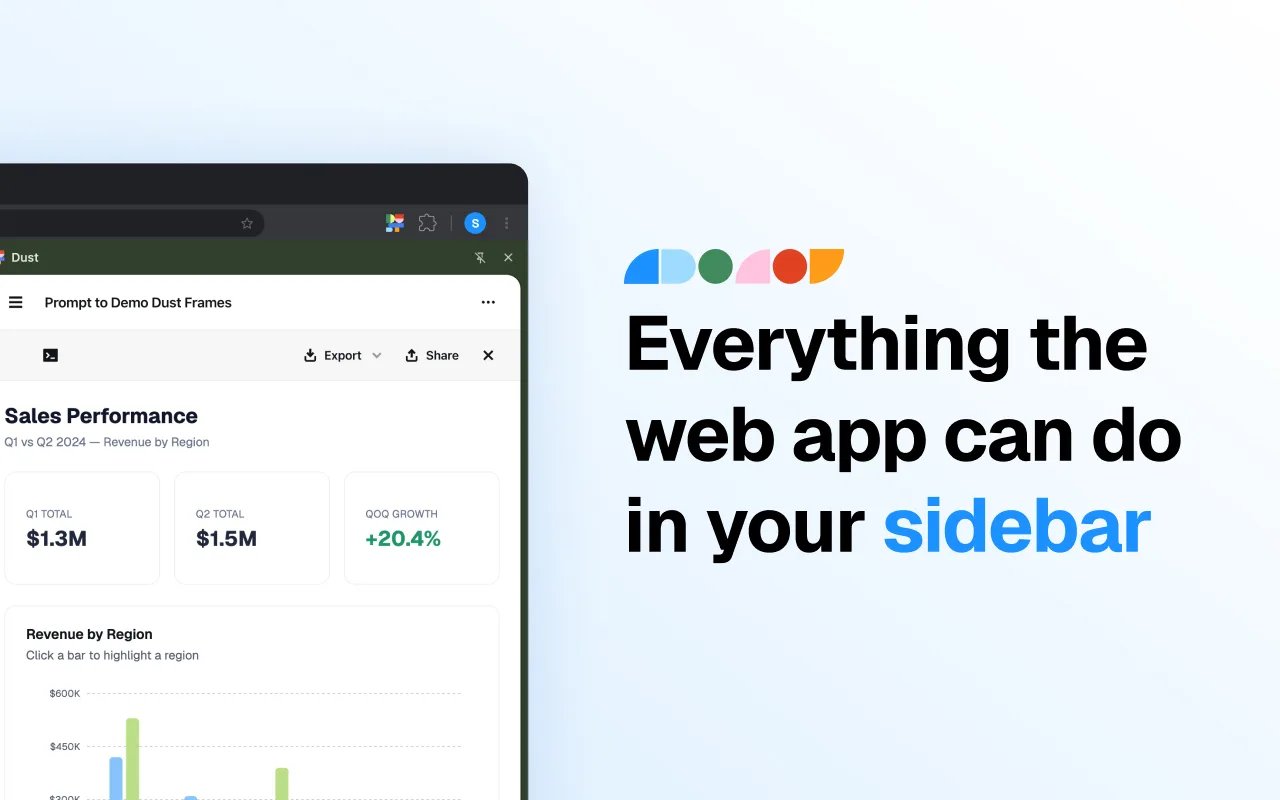
Interactive Frames transformed data into shareable and explorable experiences. Build clickable charts and live dashboards that teammates can interact with directly.
Deep Dive became the agent for comprehensive research, searching both your company data and the web, spawning specialized sub-agents that work in parallel for 10+ minutes when needed, exploring multiple angles simultaneously.
Voice mode arrived. Speak naturally to any agent. Pair it with speech generation to turn research into podcasts for your commute.
6. The platform expanded across your entire stack
Image creation and editing with natural language. Nano Banana renders photorealistic images in seconds.
The @dust global agent leveled up with memory, advanced filesystem-like search, direct data warehouse querying, and access to all Company Data tools.
SharePoint, OneDrive, Microsoft Teams, enhanced Excel automation, and Zendesk integration.
Confluence and GitLab MCP support. Claude 4.5 Sonnet and Haiku. Grok 3 models. GPT-5.1.
Customizable tool approval settings for admins. Agents can send attachments to Slack. Improved HubSpot tools with pagination and advanced filtering.
What comes next
Every technology shift follows the same pattern: first it’s hard to use, then it becomes invisible infrastructure and impossible to work/live without.
Our 2026 vision is making agents both.
Expect to see:
- Easier and quicker ways to build agents, removing every barrier to getting started
- A renewed vision for human-AI collaboration: multi-player agents where entire teams share context and collaborate with AI teammates
- Infrastructure for managing thousands of agents with the same reliability and governance you expect from your core systems
In 2026, we will continue to make it possible for every company in the world to run fleets of specialized AI agents that work alongside every team, transform how work gets done, and become impossible to imagine operating without.
Thank you for your trust,
The Dust team ❤️💙💚